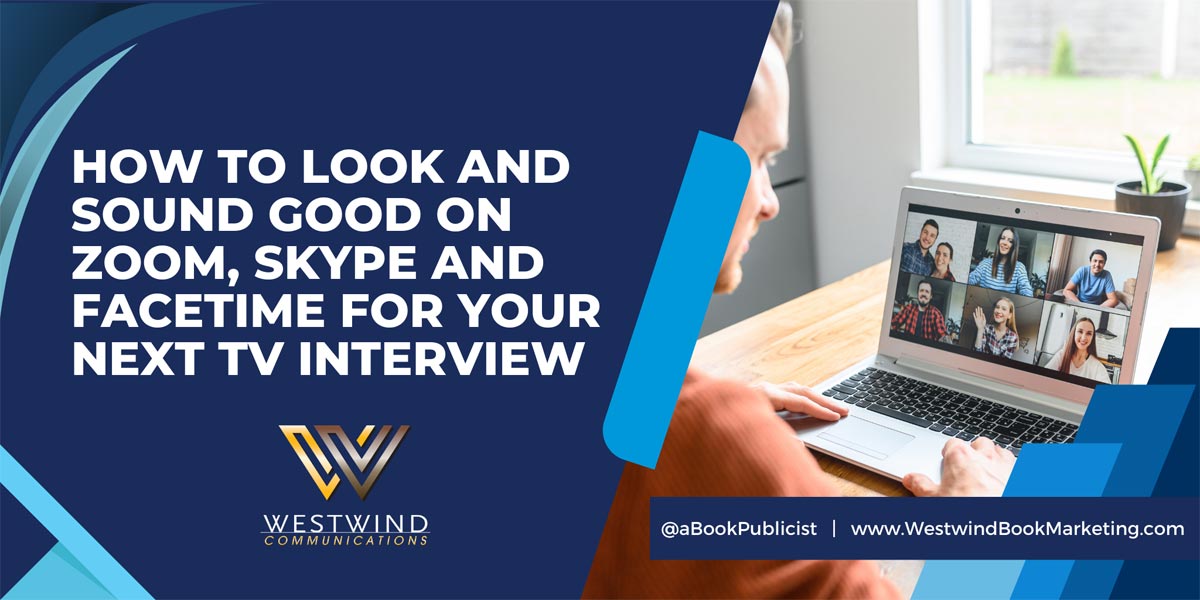
Ever notice how some people look great on a ZOOM call? What’s their secret? Media interviews that were once conducted in a TV studio are now performed on ZOOM, TEAMS, or Facetime. This presents more opportunities for interviews because you don’t have to go to a studio but there are challenges as well. Are you ready for your up-close TV interview on ZOOM?
My personal Zoom experiences and discussions with several experts in this visual field have allowed me to come up with a quick list of tips to help you crush your next Zoom call. Without further ado, here they are:
Dress Appropriately
You don’t have to dress up as much as you usually do. However, your attire should not be down more than one level from what you typically wear in the office. If you normally wear a suit and tie, for example, opt for a nice blouse or button-up shirt.
Jess Todtfeld, former producer and media trainer also recommends you avoid white, black, and red, ensure your clothing is wrinkle-free, remove distracting jewelry, and dress as simply as possible. “TV viewers should focus on your face and what you say, not your clothes,” he says.
You are the face of your company, your school, your brand. If you normally wear makeup to work, then you’ll need to wear it on a TV interview too.
Jess created a new video course on Udemy focusing on looking and sounding good for any online interview. He goes into much detail on doing the best job possible whether it’s for a media interview or a new job. Check it out at: https://bit.ly/ZOOM_Tips_JT
Invest in Reliable Internet Connection
Chances are you’ve seen someone freeze on the screen during a ZOOM session. To reduce the risk of this happening to you, a reliable internet connection is a must. If you’re in the middle of an interview and your connection freezes, a TV station will stop the interview and go to someone else. A hardline wired connection to your computer vs. WIFI can prevent this issue. In the event you must use WIFI, request that others in your home or office stay off it during your interview.
Be Mindful of Your Background
Your background during a ZOOM call is important. Do your best to make it visually appealing. Add fresh flowers, a potted plant, a painting, or your book cover enlarged on an easel. Remember that people will be able to read book titles so there’s a good chance they’ll notice dust, dirty clothes, and other imperfections in the background. Don’t sit in front of horizontal blinds as this confuses the camera and may cause pixilation of the image. (Vertical blinds are ok) Refrain from virtual backgrounds that come with ZOOM as they create distortion around your head and body. If you must use one due to a home office in a bedroom or hallway, then buy a portable green screen so you can choose a beautiful virtual background that’s free from distortions. You’ll look professional and feel good too.
Do you have a ZOOM Room?
TV and radio studios have acoustically padded walls, ceilings and are carpeted. The sound is absorbed and is not ricocheting around giving that ‘hollow’ effect. If your ZOOM Room is like a racquetball court then you need a new location or to figure out how to deaden the sound bounce with carpet, acoustic tiles, etc. Wearing a lapel microphone helps too. This should be needless say but, keep dogs, kids, and the neighbor’s lawnmower out of sound range.
Pay Attention to the Lighting
It’s essential that your face is well lit throughout the entire interview. If you’re in a dark room, use a circle light or lamp with a warm glow. Ideally, you’d be in a bright room with minimal windows. Excessive light may cause the camera lens to adjust when you don’t want it to. The cost is $50-100. I love mine and it’s really helpful on dark dreary days, late night or early morning interviews or when your spouse may need the living room light for reading!
Ensure the Camera is at ‘just a smidge below’ Eye Level
The camera should always be ‘just a smidge below’ eye level with you. Try your best to look at the camera instead of the screen at all times. Don’t let your eyes wander as this may cause others to believe you’re disinterested or disengaged in the interview. Put a little post-it notes near the camera lens on your camera to remind you to ‘look at the camera’ not the screen.
If you are using the camera on an iPhone or other smartphone, place it on a tripod and be sure to turn off the notifications and the ringer or everyone on the call will hear them.
Opt for Wireless or Wired Earbuds
Speakers on your computer are ok. But, if you want best results, get wireless or wired earbuds. They can enhance your sound quality and help you sound great on camera. If you use wireless earbuds, don’t forget to charge them completely before the interview.
Have a Glass of Water Handy
You can enjoy a number of benefits if you keep a glass of water by your side during your interview. Since talking a lot and being nervous can lead to dry mouth and throat, water can help you keep your vocal cords moist. It can also serve as a prop so if you’re asked a tricky question, you can take a sip of the water and give yourself some extra time to think of a good answer.
Don’t Forget Pen and Paper
With a pen and paper nearby, you’ll be able to jot down the reporter’s name, questions you may have, and anything that you’d like to remember after the interview. If you take notes on your computer, you’ll distract the interviewer so doing so the old-fashioned way is ideal.
Practice, Practice, Practice
Make sure you know how to work ZOOM, SKYPE, and Facetime and are comfortable with all of the options. Practice using all of these with friends and family. Don’t let your big interview on national TV be a flop because of some technical issue you could have avoided.
The Bottom Line
By following these tips, you can nail your virtual Zoom interview and meet your goals from the comfort of your own home or office.
Book publicist Scott Lorenz is President of Westwind Communications, a public relations and marketing firm that has a special knack for working with authors to help them get all the publicity they deserve and more. Lorenz works with bestselling authors and self-published authors promoting all types of books, whether it’s their first book or their 15th book. He’s handled publicity for books by CEOs, CIA Officers, Navy SEALS, Homemakers, Fitness Gurus, Doctors, Lawyers and Adventurers. His clients have been featured by Good Morning America, FOX & Friends, CNN, ABC News, New York Times, Nightline, TIME, PBS, LA Times, USA Today, Washington Post, Woman’s World, & Howard Stern to name a few.
If so, tell us a little about your book. What is the title? Do you have a publisher? What is the publish date? How many pages is your book? What is the cost? Do you have web site? What is your specific goal I.E., to make money, raise awareness, get the attention of an agent or publisher, sell the story to a movie or TV studio or something else?
Submit the form below with this information and we’ll get back to you as soon as possible. Thank you!
Would you like help promoting your book?
If so, tell us a little about your book. What is the title? Do you have a publisher? What is the publish date? How many pages is your book? What is the cost? Do you have web site? What is your specific goal I.E., to make money, raise awareness, get the attention of an agent or publisher, sell the story to a movie or TV studio or something else?
Submit the form below with this information and we’ll get back to you as soon as possible. Thank you!
As a book publicist I get asked by clients and authors about going to the National Publicity Summit in New York. I’ve attended almost every Summit since Steve Harrison started it and go once or twice a year to create new media relationships, maintain old ones and of course, to pitch my clients to the media. Through the Summit, I’ve gotten clients booked on Fox News, PBS, CNBC, MSNBC and a number of national magazines.
I represent a lot of authors. Here’s the problem: authors have to do most of the promotion of their books if they want them to sell. Even if you’ve been picked up by one of the big publishing houses, they only do so much to get you media attention. This is the reality.
So, let’s say you decide to get media attention yourself. You plan your trip to New York City, where most of the big media are headquartered. You roll into Manhattan with your strategy all laid out: “First, I’m going to try to meet with the producer of Good Morning America, and then I’m going to Fox News, and then I’m going to see the guy at Reuters. After lunch, I’m going to try to talk to the Today Show and then I’m going to stop by and see if I can talk to the producer of 60 Minutes.”
Forget about it. It’s not going to happen.
Reason #1 why I recommend the Summit for many people is access, one-on-one, to these media gatekeepers in a very efficient and organized event. But is it for every author? Depending on your situation, it may or may not make sense to go. I’d recommend it if you have a consumer-oriented, non-fiction topic. Does it have broad audience appeal? Can your book help the average person in their day-to-day lives? If so, then it makes sense for you to consider attending.
If you have a highly technical topic such as how computers work, or one about a historical event such as WWII, it probably doesn’t make sense to go to the Publicity Summit, unless you can connect your book to current trends. (In fact, the Summit staff will probably turn down your application if they feel that the media would not be interested in the topic.) Generally, fiction, poetry and books about localized topics will not do well at the Summit. For example, a book about the best bars in Chicago would probably not be of interest to the national media who attend the Summit.
Should you go if you feel you’re not ready to meet the media? Here’s the dirty little secret: no-one feels ready. Don’t worry about that. If you’re an expert with a decent topic with a unique angle, the Summit can work for you. Go there to build relationships, yes, but also go to get feedback from the news industry professionals. I’ve seen people before the Summit starts coming in thinking they’re heading in one direction, then after having interacted with 100 journalists and producers, leaving with all new information or direction…a better book title, the perfect pitch, new business ventures and relationships.
Book publicist Scott Lorenz is President of Westwind Communications, a public relations and marketing firm that has a special knack for working with authors to help them get all the publicity they deserve and more. Lorenz works with bestselling authors and self-published authors promoting all types of books, whether it’s their first book or their 15th book. He’s handled publicity for books by CEOs, CIA Officers, Navy SEALS, Homemakers, Fitness Gurus, Doctors, Lawyers and Adventurers. His clients have been featured by Good Morning America, FOX & Friends, CNN, ABC News, New York Times, Nightline, TIME, PBS, LA Times, USA Today, Washington Post, Woman’s World, & Howard Stern to name a few.
If so, tell us a little about your book. What is the title? Do you have a publisher? What is the publish date? How many pages is your book? What is the cost? Do you have web site? What is your specific goal I.E., to make money, raise awareness, get the attention of an agent or publisher, sell the story to a movie or TV studio or something else?
Submit the form below with this information and we’ll get back to you as soon as possible. Thank you!
As a book publicist, I have a unique perspective in the publishing process and see the many roles that contribute to the success of a book. Some books are masterpieces ready to be promoted while others have issues that slow down the process and kill a project’s momentum. Because I work so closely with the final product, I have a good understanding of what can make or break a book.
Besides book marketing, one of the most important things you can do as an author is to make sure an editor is a member of your team.
Authors and editors are two very different jobs. Both of these roles are equally important to book creation. However, when an author is their own editor, the lines that distinguish the two jobs can easily get blurred, and the quality of work ultimately suffers. Nothing quite compares to a book that has been properly edited with a fine-tooth comb. A polished manuscript creates potential for a much better book marketing experience overall.
The Editor’s Role on a Book Publishing Team
“Nothing detracts from good writing like bad editing,” says Debra Englander, an experienced non-fiction editor and writer. “Submit your best work. Have it copy-edited and proofread by a professional. Don’t ruin your reputation because of preventable mistakes.” Englander served as editorial director at John Wiley Publishing for nearly 17 years and was on the receiving end of thousands of pitches from agents and authors. She currently works with authors on creating winning book proposals and editing manuscripts.
In an interview with author Jane Thurnell-Read discussing how to get a book published, Englander stressed the importance of the division of labor within a book. An editor provides the objectivity that one lacks when reviewing their own work. Their job isn’t to change the meaning of a book, but rather to make it better. Englander said authors can’t always tell what a scene is lacking, or if it’s clear enough to someone who’s unfamiliar with the subject matter. After all, perception is just as important as intention in the world of book publishing.
Ensure Your Book is Publisher-Ready
An editor can clean up the original content and make awkward sentence structure and grammatical errors much less likely. These details can throw off the flow of a book and create obstacles for the reader’s comprehension. Those types of unfavorable features will likely be noticed early on in a publishing attempt and could very well result in rejection.
With over 25 years of editorial experience, Tiffany Yates Martin understands how to make the publishing process better for everyone involved. “Reputable, competent editors will save authors immense amounts of time and agony in deepening, developing, and polishing their stories, and can often give authors a leg up in attracting the attention of agents and editors, and make their stories more salable.”
Her extensive work with publishing houses such as New York Times and Writer’s Digest, has left her with the belief that editing is the most important part of the writing process. “Editing and revision are the real work of writing—and often where the story is fully found and developed and the magic happens…Because most authors were never taught this fact—nor how to edit and revise—many get disheartened when their first draft isn’t publisher-ready, or when the revision process may be more demanding or difficult than they expected. That’s not a reflection of your talent or skill but a completely normal part of the process for nearly all authors, at all levels of experience and skill,” explains Martin.
Before your book is introduced to a publisher, it needs to go through a rigorous editing process. Although being your own editor may sound enticing, no author is above hiring an editor. As Tiffany Yates Martin says, “Even editors need editors.”
Good Editing Leads to Successful Book Marketing
Aspiring authors sometimes fear that an editor will make their work less authentic, but I’ve found the opposite to be true. Hiring an editor is like hiring a personal trainer; it’s still you just faster, tighter and trimmer. The work can still get done without one, but it’s a much more tedious process. Because of its time-consuming nature, refined writing needs multiple sets of eyes to ensure that everything on paper is intentional.
There is no shame in working with multiple people to ensure the highest quality of work. In fact, it’s highly encouraged. Publisher’s Weekly points out that grammatical errors are far too common to cut out entirely, but an effort to minimize them must be made. “The writer’s primary task is to create work that is as compelling and error-free as possible. A great book cover, a marketing plan, and a cool author website are all important,” they say, “but if an author hasn’t spent the time and money for a solid editing job, it’s all just wasted effort.” Good book marketing and publicity can only do so much; the true quality of the book is essential to its success.
The Bottom Line
Authors, give yourself the best shot at success; hire an editor. Together, you can create the absolute best version of your work.
Book publicist Scott Lorenz is President of Westwind Communications, a public relations and marketing firm that has a special knack for working with authors to help them get all the publicity they deserve and more. Lorenz works with bestselling authors and self-published authors promoting all types of books, whether it’s their first book or their 15th book. He’s handled publicity for books by CEOs, CIA Officers, Navy SEALS, Homemakers, Fitness Gurus, Doctors, Lawyers and Adventurers. His clients have been featured by Good Morning America, FOX & Friends, CNN, ABC News, New York Times, Nightline, TIME, PBS, LA Times, USA Today, Washington Post, Woman’s World, & Howard Stern to name a few.
If so, tell us a little about your book. What is the title? Do you have a publisher? What is the publish date? How many pages is your book? What is the cost? Do you have web site? What is your specific goal I.E., to make money, raise awareness, get the attention of an agent or publisher, sell the story to a movie or TV studio or something else?
Submit the form below with this information and we’ll get back to you as soon as possible. Thank you!
Alliteration is a very useful literary tool. Alliteration is simply defined as the occurrence of the same letter or sound at the beginning of adjacent or closely connected words and also the repetition of an initial consonant sound, as in “a peck of pickled peppers.”
Alliteration is one of many tips and techniques covered in my new book designed to help authors title their books called BOOK TITLE GENERATOR.
Incorporating alliteration into your book title can help people remember your work and it will stick out in people’s minds.
Here are a few examples of books with alliteration in their titles:
The Teeny Tiny Teacher by Stephanie Calmenson
The Magical, Mystical, Marvelous Coat by Catherine Ann Cullen
Of Mice and Men by John Steinbeck
A Tale of Two Cities by Charles Dickens
The Great Gatsby by F. Scott Fitzgerald
Pride and Prejudice by Jane Austen
Sense and Sensibility by Jane Austen
Love’s Labor’s Lost by William Shakespeare
The Pickwick Papers by Charles Dickens
The Princess and the Pea by Hans Christian Andersen
Fahrenheit 451 by Ray Bradbury
Caesar and Cleopatra by George Bernard Shaw
The Wonderful Wizard of Oz by L. Frank Baum
Tinker, Tailor, Soldier, Spy by John le Carré
The Wind in the Willows by Kenneth Grahame
Roger Parker of Personal Branding says, “Sometimes the most important lessons in personal branding are the simplest ones, like using alliteration, or repeated “hard” sounds, to make the title of your brand-building book stand out and be easy to remember.” You want readers, fans, and your potential audience to enjoy your book’s title. Alliteration can help that title roll off the tongue nicely. If your book’s title is memorable and fun or easy to say, people will talk about it. The alliteration will stand out in conversation or in the review section of a website.
According to Mike Ball, author of ‘Banjos, Boats and Butt Dialing’, alliteration can be a very effective tool for a humorist. Ball explains, “I rarely use it for serious subjects but judiciously used, alliteration is an author’s best friend. Since humor is all about timing, alliteration forces the reader to participate in the timing you are trying to set up. That’s why my book title ‘Banjos, Boats and Butt Dialing’ gets people to laugh before they crack the cover.”
As J.R.R. Tolkien observed, alliteration “depends not on letters but on sounds.” Thus, the phrase know-nothing is alliterative, but climate change is not.”
Domey Malasarn from the website “The Literary Lab” feels that alliteration can belong in titles as well as within your book. “I have used it on occasion myself in places where I thought it was helpful. For example, if I had a sentence like ‘Alfred was furious.’ I might revise it to “Alfred was angry.” because to me it pairs the subject of the sentence with his emotion a little more powerfully.”
Puja Lalwani of Buzzle explains, “The importance of alliteration should not be undermined as just another literary device that is beyond comprehension. It is highly useful and most invaluable, whether just to drive a point home, make for a fun read, or as a marketing tool that will leave your product etched in the mind of the consumer.”
On the website, helium.com, Stella McIntyre perfectly outlines the benefits of using alliteration across various mediums. “Although most commonly used in literature, most particularly poetry, alliteration can also be found in non-fiction writing: leaflets, newspaper headlines, advertising and merchandising. Its effect is twofold. Firstly, it draws attention to and emphasizes a phrase and secondly, it can create connotations that significantly add to the understanding and enjoyment of a writer’s meaning.”
The Bottom Line: Alliteration in book titles will help people remember your book title because it will help your work stand out and engage your reader.
Book publicist Scott Lorenz is President of Westwind Communications, a public relations and marketing firm that has a special knack for working with authors to help them get all the publicity they deserve and more. Lorenz works with bestselling authors and self-published authors promoting all types of books, whether it’s their first book or their 15th book. He’s handled publicity for books by CEOs, CIA Officers, Navy SEALS, Homemakers, Fitness Gurus, Doctors, Lawyers and Adventurers. His clients have been featured by Good Morning America, FOX & Friends, CNN, ABC News, New York Times, Nightline, TIME, PBS, LA Times, USA Today, Washington Post, Woman’s World, & Howard Stern to name a few.
If so, tell us a little about your book. What is the title? Do you have a publisher? What is the publish date? How many pages is your book? What is the cost? Do you have web site? What is your specific goal I.E., to make money, raise awareness, get the attention of an agent or publisher, sell the story to a movie or TV studio or something else?
Submit the form below with this information and we’ll get back to you as soon as possible. Thank you!
You’ve landed the radio interview and it’s time to get ready to actually do it. Now what? As a book marketing expert and book publicist, I have booked my clients on thousands of radio and podcast interviews. Here’s a list of tips I give to my clients prior to their interviews. Keep this helpful list of interview tips nearby and you’ll be glad you did!
1. Go to a quiet room in your home or office; be sure staff and/or family know you are on a radio interview and cannot be interrupted.
2. Since many interviews are on ZOOM, SKYPE as well as the phone, turn off other phones, cell phones and anything else that could create background noise including air conditioners, the radio… and the kids!
3. Have a glass of water nearby; there’s nothing worse than dry mouth on a radio interview.
4. Be on time. Call the station exactly at the time they tell you or be at your phone waiting if the station is going to call you.
5. Use a landline phone for best quality. If it is not possible to reach a landline, then use a cell phone in a stationary location and not while you are rolling down the road! Do not use Bluetooth over the speaker system in your car.
6. Disable call waiting: dial *70 and then call the studio number. This disables call waiting for the duration of the phone call. As soon as you hang up, it will be reactivated.
7. Do not use a speakerphone! It’s ALL about good sound quality.
8. Be self-assured. Remember, you know your topic inside and out. Be confident in your ability.
9. Smile, smile, smile, whether on radio or TV – SMILE. You’ll feel better, and for TV you’ll look better too.
10. Put some pizzazz and energy into your voice. Try standing while you speak to liven things up a little.
11. Research the show and tailor your message accordingly. Just Google the host’s name and station and check out their web site. Is it a national audience or a small town in Ohio? What is their format? Is it News/Talk, NPR or Classic Rock or something else? You need to know.
12. KNOW exactly how much time you will have on the air as a guest, three minutes or 30 minutes…so you can tailor your answers to the time allotted.
13. Practice your sound bites—out loud before the interview. Communicate your main points succinctly. Practice this out loud.
14. Be informative and entertaining without directly pushing your book, product or service. Make the audience “want more.”
15. A kind word about the host can go a long way. It’s good manners and good business.
16. A person’s name is sweet music to them so commit to memory or jot down the name of the host and use it throughout the interview. When taking calls, use the names of callers too.
17. CALL TO ACTION. Have ONLY ONE such as “Buy my book at BookTitleGenerator.net” That’s it. Don’t mention your Twitter handle, Facebook, Pinterest, Instagram people will barely remember your name or book title. Don’t make it impossible.
18. Be careful not to slide into technobabble, jargon or acronyms that few know about.
19. Never talk down to your audience.
20. Be respectful of the host because everybody starts someplace. Today they’re interviewing you from a college radio station; in a few years they could be a nationally syndicated host.
21. Don’t Oversell. Remember you are on the air to provide useful information to the listening audience. If you are an author or selling something, limit yourself to TWO mentions of the book, product or service. You must make it interesting without the commercialism. It takes finesse but you can do it. Often times the host will do this for you and you won’t need to mention it.
22. Think of a radio interview as an intimate conversation with a friend and not a conversation with thousands.
23. Radio interviews require verbal answers, not head nodding or uh-huhs. Hand gestures don’t count in radio either.
24. Radio will often use interviews live and later cut them up for use throughout the day giving you more airplay. So, keep your answer to a 10 to 20 second sound bite. You can say a lot in that amount of time and then you don’t sound like you are babbling on. Don’t go on more than a minute without taking a break.
25. Don’t just answer questions. Tell listeners something you want them to know, something they wouldn’t know unless they were tuned in, with the promise of more of the same when they buy your book.
26. Have three key messages. Short, not sermons. Sometimes the host opens the door, other times you have to answer a question and segue to a key message. A compelling message will have the host asking for more. Usually, people can get in two key messages; the pros can get three.
27. Lazy hosts open with a lame: “Thanks for being here.” Boom! Give a :15-:20 sec summary message. If the host introduces you with a question, be polite, deliver your summary message, then answer the question. “Thanks, (use name), for the opportunity to talk about…. Now, to your question (name)…”
28. Maintain a Positive Attitude. BE GENUINE OR TRANSPARENT. Don’t fake enthusiasm or sincerity. If you’re in a bad mood cancel the interview. Don’t pretend to know stuff you don’t.
29. Re-read the press release or pitch that got the booking since the host is going to be using that as a starting point. Often a book publicist such as I, will tie into a breaking news event that relates to your expertise. Be aware of that tie-in.
30. After the interview write a thank-you note. Since so few people do this, you’ll really stand out from the crowd. And most importantly, you may get invited back.
31. Whether the interview is live or taped-live, if you stumble, or flub up just keep going. Often what you perceived as a mistake, the listeners won’t even notice.
32. Ask for an MP3 of the recording before the interview. Often if you ask ahead of time the producer will record the interview and then you can use it on your web site. If that’s not available, get the link to the station’s recording and Tweet about to your followers and promote it on your Facebook page. Be sure to listen to it later and critique your performance.
33. Listen for the testimonial. Sometimes the host will say something complimentary, “You have a fascinating story Mr. Jones.” Use it in your marketing. Or you can actually ask for a testimonial. Often that MP3 will arrive with a note from the host saying how much they enjoyed the interview, or that “Scott Lorenz was a great interview, he really kept our audience engaged,” or “the phones rang off the hook when Scott Lorenz was being interviewed.” You can use those testimonials in future pitches and on your web site, blog etc.
As a book marketing firm, we’ll prepare our clients with media coaching or if need be, training with a media trainer. We’ll also submit questions to the radio host ahead of time and include those in our press kits emailed to the stations. Often the radio host will read those questions right in order. Other times they refer to our questions and include some of them. We do this to help the host in case they’ve not had a chance to read the book, and to help direct the questioning.
Make sure you know your own material inside and out and are comfortable with everything in it. You are the author of the book, or the press release and they’ll ask you, “What did you mean about this or that?” You need to have the answer. You don’t want any surprises.
The Bottom Line: RELAX, you’ll do fine. The butterflies you’re feeling are what will drive you to do your best! Just follow these helpful tips and you’ll be a radio interview star!
Book publicist Scott Lorenz is President of Westwind Communications, a public relations and marketing firm that has a special knack for working with authors to help them get all the publicity they deserve and more. Lorenz works with bestselling authors and self-published authors promoting all types of books, whether it’s their first book or their 15th book. He’s handled publicity for books by CEOs, CIA Officers, Navy SEALS, Homemakers, Fitness Gurus, Doctors, Lawyers and Adventurers. His clients have been featured by Good Morning America, FOX & Friends, CNN, ABC News, New York Times, Nightline, TIME, PBS, LA Times, USA Today, Washington Post, Woman’s World, & Howard Stern to name a few.
If so, tell us a little about your book. What is the title? Do you have a publisher? What is the publish date? How many pages is your book? What is the cost? Do you have web site? What is your specific goal I.E., to make money, raise awareness, get the attention of an agent or publisher, sell the story to a movie or TV studio or something else?
Submit the form below with this information and we’ll get back to you as soon as possible. Thank you!